Andi’s Basement: Lighten Up, Live Your Best Life!
A young entrepreneur with a fresh MBA had a problem he shared with every friend he had in Washington, DC. They were all early in their careers, all wanted to live in the city, all wanted active lifestyles — and none of them had anywhere to put their golf bags, skis, bikes, camping gear, or scuba equipment.
City storage was expensive. Suburban storage meant a car trip nobody wanted to make. And the dirty secret of the storage industry: most people put their stuff in a unit, pay month after month, and eventually forget what’s even in there. The business model of traditional storage was built on customer neglect. Andi wanted to build one on customer service.
The idea
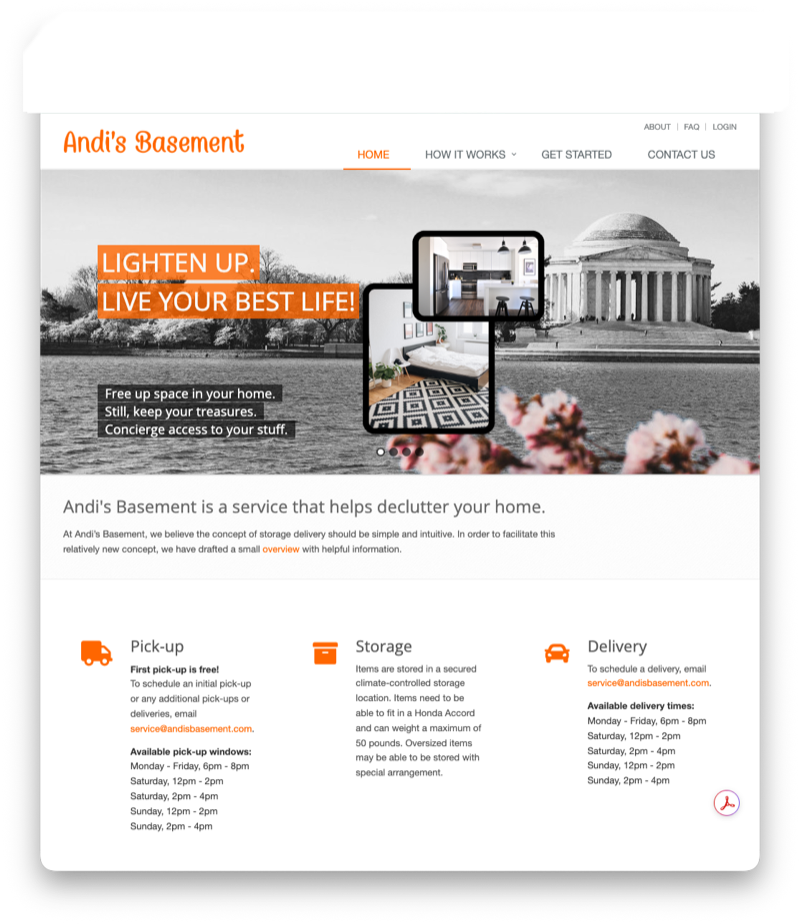
Pick up your stuff from your apartment. Store it in a warehouse. Give you a virtual inventory — photos of every item — accessible from your phone. Deliver anything back within 24 hours. And send you reminders you set when you stored it, so you never become the customer who pays for years and forgets.
It was a clean concept with real pain behind it. What it didn’t have was a business plan that could survive contact with the market, a technology platform, or a go-to-market strategy.
What SanYuHu did
SanYuHu came in as both technology partner and strategic advisor. Not one or the other — both, because in a venture this early the business model and the platform are the same decision.
Business plan validation (months 1–3). We didn’t just review the plan — we pressure-tested the market. The founder’s original thesis was young urban professionals. That was real, but it wasn’t the biggest opportunity. Our analysis uncovered a larger, more stable segment: older homeowners who had downsized but accumulated too much to part with. Their primary use case was seasonal — holiday decorations, winter gear, summer furniture. They weren’t price-sensitive the way a 24-year-old with a studio apartment was. They were volume-sensitive.
This insight reshaped the business model, the pricing tiers, the marketing strategy, and the platform features. It also made the financial model fundable. Seed funding was secured by the end of month three.
Platform build (months 3–6). We built the full technology stack:
- Customer-facing web application — service explanation (the concept was new enough that it needed teaching), online signup, pickup and delivery scheduling, and the core differentiator: a virtual closet, virtual storage room, and virtual basement where customers could browse photos of their own belongings.
- Operations platform — warehouse management, pickup and delivery logistics, inventory tracking with photographic documentation.
- CRM and marketing engine — lead management, sales funnel analytics, demographic data mining, email campaigns, automated reminders, billing, delivery and pickup notifications.
- Marketing infrastructure — SEO and SEM foundation built from day one, ready to activate after the soft launch.
Soft launch and validation (month 6). The launch was deliberately quiet — word of mouth only. No marketing spend. The goal was to validate operations without being overwhelmed: could the warehouse handle the volume? Could pickups happen on schedule? Would customers actually use the virtual inventory, or was it a feature nobody needed?
They used it. The model worked.
Marketing rollout and growth. With operations validated, the marketing engine turned on. SEO, SEM, and targeted campaigns drove growth. Andi’s Basement became the market creator in the DC area — a genuine Blue Ocean play in a category that didn’t exist before they built it.
The competitive moat
Competitors arrived. Several individuals and small companies saw the market Andi’s Basement had created and tried to enter it. None succeeded.
The reason wasn’t any single advantage. It was the combination of four things working together: a sound business model, quality service, a strong sales team, and a technology platform that competitors couldn’t replicate quickly. Every competitor brought one or two of these. None brought all four. The ones with good service had weak technology. The ones with technology had poor unit economics. The moat was the integration, not any single wall.
This is a pattern we see repeatedly in our work: defensive positioning comes from the architecture of the business, not from any one feature or capability.
Expansion
After establishing market dominance in DC, the question was where to grow. We conducted market research on expansion candidates and evaluated the landscape:
- San Francisco and New York — similar companies had entered those markets in the 18 months since Andi’s Basement launched. Both also had challenging legal and licensing requirements.
- Smaller cities — didn’t have the housing-space premium that created urgency in customers.
- Boston emerged as the strongest choice: same region as DC (simpler logistics for management and training), aligned consumer demographics, no established competitors, and familiar brand sensibility.
Boston launched successfully, extending the model to a second metro market.
The honest ending
Andi’s Basement operated for several years with positive cash flow and solid business metrics. It was, by the numbers, working.
But the founders came to a clear-eyed realization: they were entrepreneurs, not operators. Building a company and running one are different skills, and they were drawn to the former. Meanwhile, the market shifted. Traditional storage companies opened city-center locations — more expensive than suburban but cheaper than a full-service pickup model, and not inconvenient enough for customers to pay the premium Andi’s Basement charged.
A sale of the company wasn’t achievable. The team transitioned existing clients to alternatives, ceased operations, and liquidated assets. It was a clean, responsible wind-down — not a failure, but a completed chapter.
SanYuHu had been an equity investor from the seed round, contributing discounted software development in exchange for a stake. When the company closed, the founder transferred the Andi’s Basement brand, domains, and digital assets to SanYuHu as a gesture of appreciation for the partnership.
What this case proves
This wasn’t an AI engagement — it predates our AI-first practice. But it demonstrates the core of how SanYuHu works, regardless of era:
- Strategy and technology are one conversation. The business plan and the platform were designed together. Changing the target market changed the features, and discovering the right features changed the business model.
- Validation before scale. The soft launch wasn’t timidity — it was engineering discipline applied to a business. Test the system under controlled load before you open the throttle.
- Defensive positioning is architectural. The moat wasn’t a feature. It was the integration of four capabilities that competitors couldn’t assemble simultaneously.
- Honest endings are part of the work. Not every venture becomes a forever company. The measure is whether the method was sound and the execution was clean. Both were.
The Andi’s Basement platform, brand, and domains now belong to SanYuHu — a working artifact of a partnership that did exactly what it was designed to do.